Get In Touch With Us
Connect with Arena Multimedia
-
CALL ANY TIME
-
SAY HELLO
customercare@arena-pakistan.com

About The Course
The ADMS (Advanced Diploma in Media Studies) is a 2-year International Advanced Diploma designed to provide students with comprehensive training in Graphic Design, Broadcast Media, and 3D Animation. This program prepares students for exciting career opportunities in the digital media and entertainment industries by equipping them with industry-standard skills and software knowledge. In addition to practical learning, students will have access to Pro Connect, Arena's exclusive digital learning platform, offering 24/7 access to course materials, video lectures, and certification guidance. Furthermore, this diploma serves as a pathway to an international degree, enabling students to further their education at global universities.
Learning Outcomes
- Understandthe fundamentals of graphics and drawing techniques.
- Learn typography principles, evolution, and practical applications.
- Create artworks and illustrations using digital tools.
- Use image editing software for retouching and enhancements.
- Master post-processing techniques using Lightroom.
- Explore print advertising and its functional aspects.
- Design and publish magazines, brochures, and page layouts.
- Understand storytelling and screenwriting fundamentals.
- Learn storyboarding techniques for animation and media.
- Create, record, and edit audio content.
- Develop digital motion graphics and composite images.
- Edit and composite videos professionally.
- Explore 3D modeling, rigging, and animation for motion graphics.
- Create broadcast motion graphics and promos using Cinema 4D.
- Learn color grading techniques using DaVinci Resolve.
- Apply techniques to create 3D model assets in 3ds Max.
- Use advanced lighting, shaders, and textures.
- Learn animation utilities and special effects.
- Render using V-Ray for high-quality outputs.
- Explore real-time rendering solutions for architectural visualization
- Develop 3D models using advanced tools.
- Master texturing, painting, and sculpting with ZBrush.
- Create and edit high-quality textures for animation aesthetics.
- Paint textures for characters and 3D assets in Substance Painter.
- Implement studio lighting techniques in Maya.
- Apply rigging and animate characters for productions.
- Learn Advanced Compositing using Fusion.
Career Opportunities
- Graphic Designer
- Illustrator
- Layout Designer
- Visualizer
- Photo Editor
- Audio and Video
- Editor Compositor
- Rendering Artist
- 3D Animator
- 3D Modeler
- Texturing Artist
- Lighting Artist
- Rigging Artist
- CG Modeler
- Storyboard Artist
Term 1: Graphic Suite Description
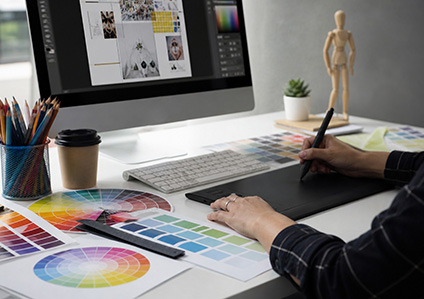
Semester 1 of the Graphics Designing Suite introduces the foundational concepts of graphic design, visual communication, and digital design tools. The semester covers basic sketching techniques, image resolution, typography, and design fundamentals, along with hands-on practice in industry-standard software such as Adobe Illustrator, CorelDRAW, Photoshop, and Adobe InDesign. It includes working with vector and raster graphics, layouts, colors, text, advertising concepts, and print media. The semester also focuses on creating, editing, exporting, and preparing graphics for web and print, while building a strong base for advanced design studies in subsequent semesters.
Term 2: Broadcast Media Suite Description
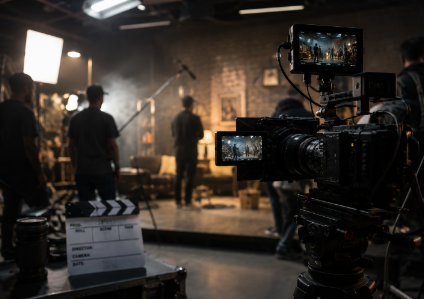
This semester introduces the concepts and practical techniques of scriptwriting, story development, audio production, and motion graphics. It covers basic to advanced aspects of scriptwriting, including film proposals, story outlines for animation and films, script development methods, and storyboard creation with an emphasis on visual storytelling and movement. The semester also includes audio production fundamentals such as sound capturing, importing, and editing audio using professional tools.
In addition, students work with motion graphics and video editing concepts, including text animation, expressions, frame rate manipulation, visual effects, masking, color keying, and the use of paint, clone, and puppet tools. The semester further explores 3D space, layers, and properties, along with importing, trimming, and editing audio and video footage, setting In/Out points, and managing timelines for professional-quality video and animation projects.
Term 3: Animation Suite Description
This semester introduces the fundamentals and advanced techniques of 3D modeling and motion graphics. Students learn to create, texture, light, and animate 3D models while applying the principles of dynamic camera movement to enhance visual storytelling. The semester covers the use of various shaders, materials, and textures, along with rendering techniques in VRay. Students also explore different modifiers and tools in 3ds Max to produce high-quality motion graphics, combining creativity with technical expertise in 3D visualization and animation.
Term 4: Advanced Animation Suite Description
This semester focuses on advanced 3D modeling, texturing, lighting, and character animation using Maya. Students learn to work with standard, NURBS, and polygon primitives, block cartoon characters, and create detailed facial morph targets for expressive animation. The curriculum covers shading, procedural textures, bump and displacement maps, skin shaders, and surface luminance utilities, alongside realistic lighting techniques including global illumination, moonlight, and caustics.
Students also explore Arnold camera types, volume shaders, and various material application methods, while gaining hands-on experience in character rigging, inverse and forward kinematics, constraints, set-driven keys, and skinning techniques. The semester emphasizes morphing, blend shape deformers, functional facial rigs, and the development of complex muscle systems, equipping students with the skills to produce high-quality, professional 3D animations and motion graphics.